Showing posts with label topbar beekeeping. Show all posts

Tuesday, 5 April 2016

Sprung has Springed

This last week has treated us to a little sunshine and all of a sudden the world is coming back to life.  I was extremely lucky to have booked the time off of work and feel very smug as a result. The week was spent with family, on the beach, visiting seal colonies nearby, fossil hunting, and celebrating my birthday.
image
image
My daughter also finally got to do her "zookeeper for a day" Christmas present and even got to hand feed owlets, wallabies, and meerkats.
image
As I have said all three of my colonies made it though winter and on brief inspection have a small amount of brood. The top bar hive is by far the strongest and even has some winter stores left over at the tops of a few combs.
Since I felt my sap rising too I jumped on the impulse and got my bait hives out ready. This is in spite of fact that I never see a swarm before June :s To be fair this is mostly because I just concentrate of my village area. This is to try and catch any of my swarms along with any local survivor stock. Here is recent post on how. I have also baited up all my empty hives in the apiary as.... well... why not! I want to let my colonies swarm with some degree of regularity as I believe it to be an important process both for the bees and in varroa control. I will attempt to minimize swarming through nest expansion but if I miss the boat and the urge takes them who am I to know better. I may make splits using the swarmed colony if it is large enough but otherwise I will not intervene unless there is queenlessness.  I am lucky that I live sufficiently rural that I can get away with this malarkey, but I put bait hives at different distances in my village to minimize the bees upsetting anyone. It does annoy me a little that a hive swarming is treated as such a terrible thing in beekeeping now when I instinctively feel as though it should be celebrated.
20160316_170348
Warré baited up for swarms. Just two of the four boxes.
As well as bait hives of my own I have lent our local vicar two warré bait hives. Joe is very excited to be giving natural beekeeping a try and currently supports nine churches. That is nine churchyards that may well be hearing the buzzing of bees in the not too distant future.
I will publish a short video in the not too distant future of how I set one up.

In other news over winter I have contributed to the YBKA newsletter (March edition). This is the monthly publication of
the Yorkshire Beekeeping Association and had a new editor who wanted to capture some different beekeeping practices.
I will also be hosting my association in my apiary for a Top bar hive training session on 21st May, so fingers crossed I have something to show them.


Sunday, 13 March 2016

Long time no bee

Well it has once again been a long winter's break for me and beekeeping. I have had to find other pass times like snowflake cutting, visiting relatives and getting under my wife's feet. I didn't really blog much towards the end of last year either to be honest. I found last year an extremely challenging beekeeper year. The summer was terrible for the bees here and for the first time I have seen the queens stop laying. I was checking hives and finding no eggs and thinking they had gone queenless. A few combs further on and there her majesty would be. It is the sort of year that tests your principles as a natural beekeeper. I found myself relenting and giving a little top up feed towards the end of the year. Nonetheless I was expecting the worst coming out of winter. This weekend has been the first signs of spring in North Yorkshire with temperature actually reaching double figures for C. The sun seemed a little dazed and confused by the whole thing but managed to burn through the haze and put on a good showing.
I popped over to the hives yesterday lunchtime  and not a bee could be seen flying. I had been to the association apiary (nearer the coast) earlier in the day and all hives were flying strong. I lifted the top covers of my quiet hives and had a look at the small fondant blocks I had put on in February (I lost several colonies to starvation in Feb last year). None of the fondant had been touched and there were no bees in there *sigh*. In the kenyan top bar hive I pulled the follower board back expecting the worst and out came some bees wondering what the hell I was doing. They had made it wooooooooo! Well I was one for three (I understand this is an Americanism and I realise now I am entirely unsure whether this is the correct usage *shrugs*). I checked the next hive and the same start of fondant untouched and no apparent bees, but when I open them bees aplenty. I could not believe. All three of my hives had made it through winter and had shunned my fondant and made it through winter on honey fumes. Well done girls, well done.
This post is a little light on media so here is a really cool timelapse from national geographic.
https://youtu.be/f6mJ7e5YmnE?list=PLGsVoZfcQfN5TlrzSA_3fVVMVn2qPv1Ve

Monday, 29 June 2015

A Bungling beekeeper and some worrying wasps

The weather forecaster had warned us of a wet weekend and was characteristically wrong. This weekend was the hottest so far this year, though its competition has been wanting. My saturday morning dog walk was one of discoveries. I noticed a lot of wasps at the kids playhouse and on investigation found a wasp nest the size of a melon. Having set up a vespa exclusion zone I continued on the walk and decided to visit my apiary and check on the activity at my swarmed warré. The activity looked good and I feel good about the new queen's mating chances. Then I notice scout bee activity at the empty hives.  The scouts were coming and going quite rapidly and I was easily able to track them a big ball of bees in a hawthorn bush.
image
I ran back home and grabbed my kit and my assistant beekeeper Kyle.
The first job was to trim back the surrounding bush which was quite twisty and overgrown. It was at this time that I made a boo boo. I managed to cut the branch that the swarm had clustered on. The bees unceremoniously took to the air. Having realised my incompetence the bees decided they needed to make things a little easier for me and re-clustered on a stack of two bait hives. Initially they looked as though they were heading into the bottom box but 30 min later they had reformed on the top box.
Swarm clustered conveniently on a bait hive.
This time all I had to do was scoop them up in my hands and put them in the box. The bees didn't seem to mind at all, I'm not sure what it was like for them but for me it was very warm and tingley. I saw the queen and she was surprisingly small and completely black. I think this was a cast swarm from our poppy hive. The Queens from this hive we have decided to name after the flowers in bloom when they emerge. Having given a list of current flora to Kyle he decided the new Queen should be called "Dog rose". I am very proud :)
Queen Dog rose
Queen Dog rose
As for the wasps I am afraid they met their demise in the evening. A bee suit can be used for evil as well as good!
My attempt at a video blog.

My photos and images backup automatically to google+. Occasionally it presents me with an "autoawesome" image. This is what it did with the swarm bits, a bit more dramatic than my attempt:

Monday, 18 May 2015

The Student becomes the Master

Last year I managed to interest my dad in the way of the bees.
Having kindly produced some new warré boxes for me I sent my dad back with a top bar bait hive to try out on the roof of his shed. lo and behold within a few days some bees turned up. These bees were passed on to a natural beekeeper in his area (250 miles to my apiary was a little too far).
This year he decided to knock himself up some warré boxes and put them on the roof of his shed to try his luck again. Following weeks of telephone conversations asking me about entrance sizes, lure types and amounts, the direction the hive should face and updates on "interest" from honey bees in the area this happened.


They moved in last monday just after my parents returned home from a weekend visit to me in Yorkshire. They look to be the same bee strain he caught last year so may well be from the same apiary and from the look of things almost certainly a prime swarm. It is still a little early for swarms in my area so I am in all honesty a little jealous. He is currently trying to decide how much management he would like to perform. He is considering running this as more of conservation hive but for the time being is just enjoying watching them fly.

Wednesday, 14 January 2015

When wondering what to do with wax

Any natural beekeeper practising a crush and strain approach to honey harvest,  any who have removed warped combs, or just downsized for winter by removing empty comb, will at some point find themselves with something of an abundance of wax.
Annoyingly, when I was starting out last year wax was something I coveted only slightly less than bees. Wax enabled me to weatherproof my hive (by mixing with linseed oil), to rub around the inside of the hive to make a more attractive home to the bees, to
embed upon the comb guides to aid in straight comb. All of this I could buy but what I wanted more than anything was some old comb to include in bait hives.  Old brood comb above all other things (including queen pheromone) is most successful in attracting a swarm.
Looking back on this shortage is a little odd now I have wax coming out of my ears (apologies a poorly chosen euphemism *yuck*). I harvested a relatively modest amount of wax this year in reducing the hives for winter (about 15 combs in all).
image
First I tried just melting it all in a saucepan of water. I do not suggest using your best saucepans! Anything you use to prepare wax should be something that you never want to use again for anything else... ever.. I also used a camping stove so as not to ruin the range cooker. Once melted pour the contents through a sieve (that you never want to use again for anything else) or some cheese cloth. Anything that will filter out the particulates.
image
For a few combs this works just fine. As the wax cools it floats to the top with any remaining rubbish on the bottom. Bigger projects however require bigger thinking.
If working with wax is something you're interested in there are plenty of plans on the Internet for wax extraction in solar and steam (using wallpaper steamers) extractors. Here is my home-made attempt at a steam wax extractor using a packing box and a wallpaper stripper. It worked surprisingly well and cost nothing beyond what I already had.
image
Next year I intend to build an extraction hive I can put the combs in and attach the steamer to. Once you have your wax it's fun time. I am by no means an expert like Judy Earl (as reported on Emily Scott's blog) but have really enjoyed tinkering.
My first wax product attempt was a basic lip balm.
1 tablespoon of wax
4 tablespoons of extra virgin olive oil (so it would be green).
1 teaspoon of honey
5 drops of peppermint oil.
It was a little experiment using things i already had. I mixed them together in and old (but cleaned out) sauce jar in a saucepan of water on the hob. I was quite pleased with the outcome, as were many of my work colleagues who got a free gift the next day. My wife however was ridiculously excited. The next day I came home to an ebay bill for the following products.
image
Six different essential oils, cocoa butter, jars of different sizes, borax (tut tut), three different carrier oils (?), a kindle book of bee products. Beekeeping has thus far failed to interest my wife in any way. The making of home-made cosmetics however...that she could get on board with.
Next up. My wife wanted to make a body butter (I don't really know what this is). We found a recipe, pinterest appears to be a huge resource for this, and set to work. The recipe called for water and borax to be added. As a biochemist I recognise water as a possible source of bacterial contamination and borax as something you use to scrub your steps. The borax is probably to emulsify the oil and water allowing them to mix. I wasn't too happy with this so thought of a different way. So was born the 'Lavender and Vodka Body Butter'. I am told it works well, though for what I am still unsure :)
Taking this another step I thought a lighter lip balm could be approached the same way. Behold the resulting Sloe gin lip balm.
image
This is:
1 tablespoon wax
3 tablespoons oil (in this case white grape oil but olive is fine)
1 tablespoon sloe gin.
This mix requires whisking as it cools (I used 2x bamboo skews). This made 4x 5ml pots and apparently is more of a lip gloss! Who knew!
We have also managed to make a sleep balm, containing oils from lavender, chamomile, valerian, bergamot, and orange.
image
To be honest whilst making it the smell was so powerful as to be nausea inducing. The following day when the mists had cleared and the wax had set the smell was much more pleasant.
For a beekeeper the winter is a time of fretting and carpentry. Both could well be aided by some well worked wax.

Wednesday, 17 September 2014

Change of weather, Change of fortune

I have been keeping an eye on the hives of late but not messing about with them too much. The weather is flowing inevitability towards autumn and with the shortening of the days comes the slowing down of the hives.
I can no longer inspect (open inspection) the hives after work in the evening. It is just a little too cold for my conscience to allow. That only leaves me with weekends to open them up, and the weather in Yorkshire is.... unreliable.

Formally Phoebee
This hive swarmed whilst I was on holiday and I have been waiting for signs of a laying queen. Whenever I have tried to inspect this usually placid colony has been extremely reactionary. A change in temperament like this was not a good sign but I hoped for the best. The activity in this hive however has continued to drop off. I managed to fully inspect the hive this weekend and things really don't look good. There was the crack of propolys on opening, a further sign of the march towards winter. Once open the bees gave me no trouble and appeared listless. There were bands on honey at the top of 22 combs and I removed any empty to reduce the hive to a more manageable size for them.

I have never been a whiz at queen spotting but this hive's queen (and her daughters) are particularly hard to spot. Their markings have all been VERY similar to the workers and are all quite skinny.  Still I looked hard and found not a monarch.

The brood pattern was spotty and very bumpy suggesting drones.  Whether this is a drone laying queen or a laying worker at this stage I think it is unimportant.

You get an idea of how they feel from this comb really. Queen cup anyone? I fear I may have to shake these bees out in front of another hive one evening so they can find a new queenright home. It is just too late in the year for a brood transfer.

Boudica's bees
It might not be summer anymore but someone forgot to tell these girls. On sunday it was grey and overcast with a little mist in the air. Boudica's hive was as busy Heathrow on a bank holiday.

Opening up I notice there were still a few squatters in residence. I am afraid I had to well and truly block their route of entry this time as I will be putting the insulation board in later this week.
is that one pulling out a pin?

On opening the hive I noticed the propolys was still very soft and sticky. The colony is obviously having no trouble maintaining a good temperature. The bees were still festooning in places suggesting comb building is still underway. There is still a solid brood pattern and fresh eggs.


I removed the remainder of the comb from the brewery bees. You can see in the picture below how they chewed down the comb to expose the larvae. This reduced the hive to 18 bars. Not all of the bars are fully built out so they should have plenty of space for the rest of autumn but not too much to keep warm in winter.
All in all I am really pleased with this colony.  After the shaky start we had we are getting on well and the bees are doing well.

I ended up with quite a bit of empty comb from both hives. Any good empty comb I placed behind the follower boards to help out next year. I only removed the comb that was very old, wonky or had high drone cell content.

My wife has a fancy to make lip balm but we shall see! Next update on Warré hives in a few days...yes... I said hive's'!

Wednesday, 10 September 2014

By eck it's bin awhile

I think I need to start this blog entry with an apology.  I have been remiss in my duties as a blogger. I started a new job in July leaving me less opportunities for online time. I am sorry for not keeping you all up to date on my poor long suffering bees and the meanderings of my mind. To try and make up for it (and because this blog post is quite light pictures) here is a photo of a bee taken at The Eden Project in cornwall.

The combine of the queenless brewery bees and boudica's hive seemed to go well. There was certainly no bad behaviour externally that suggested the colony was undergoing internal struggles. I left them alone for a full two weeks before sticking my nose in for check up. They were no more defensive than usual and I noticed all the comb from the brewery bees was empty. All the stores were gone, presumably moved. More surprising though was all the drone brood was gone too. Looking at the comb which contained the brood I noticed it had been chewed in. This may have been bees harvesting the wax to use else where but there were small white blobs on some cell edges (not varroa btw). On one of the combs that contained younger brood when I put them in, there were a few larvae with the cell chewed down around them (so they stuck out) with workers nipping at them!  Admittedly I am not that experienced but I have never seen anything like this. The colony has appears to have decided that the drone brood was just unacceptable. Why bother to wait and have to evict the drones when you can eat them and get a bit of protein into the bargin. I didn't disturb the brood nest at all and removed the crosscombed bars from the brewery bees hive.
I hope to do a proper inspection this weekend and update on all the hives so stay turned.

Wednesday, 6 August 2014

Hop Queen the Drone layer

Well Kyle's first supervised inspection took place on friday. He inspected the brewery bees headed up by the Hop Queen. This was a swarm that arrived on the day we visited the Great Yorshire Brewery.
It was clear during Kyle's inspection that there was much more drone brood than any recently arrived swarm has any right to have. As such I went in and checked myself without my "helper" :)

Solid drone brood and a beautiful pollen pattern


As you can see there is 100% drone brood. The drone brood is also housed within worker cells so it isn't something the colony has chosen, it is something forced upon them by their situation. There are a few reason how I know this a drone laying queen rather than a laying worker:
1 - There is a roughly normal brood pattern. Laid as closely together as the drone sized brood allows. With a laying worker it would be a lot more scattered about the place.
2 - The eggs are one to a cell and laid in the bottom. Laying workers will lay mulitple eggs and lack the full length abdomen required to reach the bottom of the cell so the eggs are on the sides.
3 - Oh!.... and we saw a queen in there on friday. If I am honest this is the main way I know, but it is worth considering the other points too :) But then you'd know that if you'd read my last blog :p


Some cross comb. Lots of drone brood and a hopeful queen cup.

It is a real shame that this queen will come to nothing as the way in which the bees have laid down their pollen stores, in a circle around the brood rather than just arching the top, is a trait of the british black bee suggesting these bees might have had some genetic link. The cross-comb shown in the picture above is minimal and only covers two bars so I can easily remove it and attach it to a seperate bar and let them join up the gap. What you may notice on that cross-comb is a hopeful little queen cup.

So the bees clearly recognise the problem. In fact the roar from the hive was alot like the one I heard in a hive I had that went queenless a while back. So what are my options:
1 - "let nature take its course". In time these bees will simply die off leaving empty comb which can be donated to another hive. 
This seems a little unfair to the bees and waste of a potential workforce (bad manager!).
2 - Donate some brood. Given some eggs and young brood the bees could raise a new queen albeit not 'their' own genetically.
There are a few problems with this idea. Firstly and Majorly they won't have a queen for another month. With it already being August this does not give them enough time to build up for winter. There is also a danger they would swarm again and further weaken themselves. A lesser problem is that I was only intending to keep this colony for genetic diversity within my queens (and therefore mating drones). This would give me another queen with the same/similar genetics before I have decided which queens I want to propergate from. It would also slightly weaken the donor hive at a time when they need all the bees they can get.
3 - Buy a queen. Queens can be easily purchased on the internet to arrive the following morning in an inroduction cage. They cost between £30-40, which in bee keeping terms isn't a lot. After a brief introduction period the queen is released and can begin laying right away.
Hmmmm I think the purchasing and import of genetically pure races of bee is shady at best. I truely believe local bee populations should be able to stabilise genetically which will allow them to properly react to selection pressures provided by their environment, diseases, pests, and (hopefully) to a lesser extent the beekeeper.
4 - Combine with a queen right colony. This would involve removing The Hop Queen (drone layer) and transferring the comb into another hive that is queenright. The bees need to be 'introduced' or they will fight. A traditional method is using a newspaper combination. A sheet of newspaper is put between the two colonies with a few slits cut in it. By the time the bees have chewed through the paper the scents in the hive have equalised and everyone lives happily ever after. This works well with conventional vertical hives but is a little tricker with a horizontal hive. It can be done though with either a modified follower board (hole in the middle with some newspaper covering it) or simply by masking taping a sheet of newspaper in place between the bars. Since the fighting is triggered by scent I have heard of people spraying the bees with air fresher *eeek!* and walking away. My current preferred method is to dust the bees with icing sugar (powdered sugar), as well as a few combs worth of bees at the end of the hive you're adding it to. This works well in a horizontal hive as sugar dusting is easy, does a improntu mite treatment, and by the time the bees have finished licking the sugar from each other they are all friends (or at the very least work colleagues). You should remember though to buy sugar free of caking agents, or grind your own. This way of combining will also allow you to put the combs within the relevant part of the hive rather than only at one end.
This will ultimately not result in me having another colony but it can potentially strengthen another colony on the approach to winter. However, this comb contains a lot of drone cells which the colony would have to look after and feed.
5 - Make them queenless and then shake them in front of another hive. This would involve removing the queen and leaving them without her for a few days. Theoretically, I can wait till the evening and empty the bees from the comb anyway from the current hive. Without the hive to return to (because I will have moved it) the bees will return to any queenright hive in the area strengthening their workforce. Again theoretically, that volume of flying bees entering a hive in the evening should mean there is no fighting. I could then feed the drone brood to the chickens.... they are in support of this plan.
This has the benefit being able to temperarily bolster any of my hives. The comb could then still be donated to another top bar hive for them to use for stores.

I am currenly torn between options 4 and 5 and would be interested in hearing peoples opinions so please comment.

In other news on checking Boudica hive to see if it would be able to provide a brood donation look who is back!

I had (I thought) removed these critters from Boudica's hive roof but as it happens they have managed to find another way in and rebuilt their nest. This is one of the babies all grown up. All six of the babies were present so either they hadn't left home or they were dropping off some washing for mum.  


Saturday, 19 July 2014

Cover me I am not going in

It is true that I have been itching to get into those hives. It is also true that I am curious as to the progress of all five colonies. It is not true that they need me poking around in their business. Each time I have both the opportunity and inclination to perform a hive inspection I am trying to ask myself the question "What am I trying to achieve?". If the answer is "I don't know", or "I just fancy a look" then I am going to fight the urge to open'er up!
As we enter the run up to the end of July the laying rate of the Queen will begin to drop off, the nectar flow will slow or stabilise, and risk of swarming will reduce. Since I feel as though there is less need to be searching for queen cells I decided to assess the colonies externally. There are different types of hive inspection and indeed observing the hive entrance can tell you a lot. The book linked to here within the Biobees forum library outlines season by season the observations that can made and their meanings. This also meant that instead of carrying a hive tool, water mister, and box of spare topbars I could take my camera!
The Brewery Bees:
The newly arrived swarm have now been on the roof of my shed for a week. I am awaiting one of two new natural beekeepers to collect them as their first colony. The Hop Queen may be an early queen from this year or one of last year's queens. The shear size of the swarm suggested a prime swarm and the fact that there was pollen being taken in within 3 days certainly suggests a laying queen is present. Being on the top of my shed I pass them every morning on the way to the car and several times in the evening. They are active from at least 7:15am through to at least 9:00pm. That is a long work day.
orange pollen going in
Grey pollen possibly bramble
By tapping the top bars with my knife handle I can also guess they have 5 bars worth of comb so far, which isn't bad going for a week. Since they are new to this bait hive even a prolific colony will be fine in there for at least about two-three weeks so no need to actually go in. If fact I wouldn't inspect these until they are in their final destination hive. All the bars can be transferred in one go keeping the cluster intact for minimal disturbance.
Phoebee's Girls:This remains the busiest hive by far. Following the combine of the queenless section of the hive with the queenright side the entrance activity has only increased. There are no large numbers of dead bees outside the hive and despite the HUGE number of bees they haven't become defensive. This suggests the combination has gone ahead with little in the way of resistance. Again by tapping the hive there is significant activity along the full length on the hive suggesting they are making use of the empty comb the queenless colony had.
Phoebee's Hive extremely busy at all entrances. A cloud of bees coming and going.
Following the start of a little rain everyone coming home.
Obviously with this many bees and at a time of year when wax building is reduced there is a danger the comb will be back-filled and the colony will swarm. HOWEVER, they don't need to build any wax the colony combine has just "donated" them at least 10 full combs to be getting along with. Lots of space, no need to swarm (fingers crossed).
Warré hive (the sneaky bees):Since the new roof, box underneath and the holes being plugged this colony has steadily built in strength. There appear to be a few more bees flying each day. Looking through the viewing window I can see bees investigating the second boxes topbars. There is a danger that the colony will see this second set as a false floor and swarm. I have a few bait hives out and can look to see if there is any scout bee activity. This obviously tells me if any bees in the area are thinking of swarming rather than specifically my bees but it is useful none the less. 
Sneaky bees 190714
Hopefully the slow and steady growth Mata Hari is leading will allow the comb building to stay ahead of the laying.
Poppy hive:This hive is not nearly as busy as they were when they first turned up. This may very well be a result of a post-swarm 'lag' when the bees from the original swarm are dying off and the new bees are not quite flying yet. They will also have brood to look after rather than only foraging to do. It will take a while following a swarm for bee numbers to reach an equilibrium. This hive is definitely busier in the morning than the afternoon and I remember they propolysed the bait hive heavily suggesting they may be caucasian race. I doubt they have made any roads down into the bottom box nadirred a few weeks back, but the fact that it was nadirred instead of superred means they shouldn't be losing any heat.
'hey dude! you're going the wrong way'
With the fact that they are a recent swarm, the space I know is in there and the drop off in activity further swarming is currently unlikely.
Boudica and the Iceni (meany bees):Much more chilled out and not at all defensive at the entrance. It may be that the defensiveness I have seen is all just a hangover from the terrible installation I performed. Add to this the colouring I have noticed on Boudica herself suggests that these may also be a caucasians bee strain. They are well known for taking a long time to calm down after a challenge. This makes sense as if I am collecting another beekeepers swarms they are likely to have all the same or closely related bees.
much calmer at the entrance
During the last inspection I provided a few extra bars and noted they are not expanding fast. This colony had wax starter strips instead of comb guide on their first bars so they have built across a lot of bars but have wide shallow comb. They therefore have lots of space to still expand down. They are covering at least 11 bars with a few spare for building. Recent swarm with space available and little time to build stores so swarming again unlikely.
So I have managed to do an inspection of each hive without removing a single bar. How stupid am I going to look if they all swarm now :)

Forage Alimighty

I haven’t inspected now for a week and a half and truth be told I am itching to see how things are going.
How has the recombine gone for the previous double hive? Has the extra comb meant that all those bees finally have someone to put stores ahead of that prolific queen of theirs’?
How are Mata Hari and the sneaky bees getting on now they don’t have a leaky roof and a hive that resembles a colander?
Have the poppy hive managed to grow down from their colossal cross-comb catastrophe into the box below? I have heard that post june there is lot less comb building done. I am still concerned I have given them too much the achieve.
As for Boudica and the meanie bees (as Kyle calls them) I am a little less curious.  They have made it clear that they want space. Space that is roughly the same size and shape as me! In honesty they are more nervous  than mean.  Even the way they move about on the comb appears more frantic than the other colonies. The brood nest is expanding in a single direction in the hive with some stores placed at the other end. I have found (supprisingly) that they seem to prefer me inspecting from the brood end. As soon as I remove the follower board from the stores end they get very interested in my face as a possible dartboard. .. It may be that the one of the other colonies is performing some robbing. Which would explain the defensiveness.
On a walk past last night despite the weather (which has been typically English) all hives had bees out flying. Hardy Yorkshire bees and no mistake. The blackberry and elderflower flow is obviously finished. The bees loss being our gain as the berries start to form. I am already collecting empty bottles from friends for wine making. The main nectar at the moment seems to be Himalyan balsam, lime trees, poppies are still going strong (from the oilseed rape fields), as well as a glut of rosebay willow herb. The gardeners of the village are doing us proud with micklemass daisies and still plenty of lavender to go around.


Thursday, 17 July 2014

The Sins of the Son visited upon the Father

As you may or may not know this weekend another swarm arrived.
As you may or may not know my parents were visiting and witnessed the spectical.
As you almost certainly do not know my father was intrigued by the event. So much so he 'borrowed' one of my bait hives to put on his shed roof to see if anything happened. He placed the bait hive on monday, come wednesday and he has bees! This year is clearly a very good year.
I am told there is lots of entrance activity and pollen going in so this could well be a prime swarm. He has asked if I can find someone who would like them in the area. Anyone in East London/Essex want some bees :)

Tuesday, 15 July 2014

Look who's come to visit

I was heading into the vegetable garden and what should I see but a swarm taking up residence in the bait hive on my roof. I still haven't witnessed a swarm in the air, or clustered on a branch but this was still very cool. To see so many bees clustered to the front of the box and in the air one minute. Then the next minute they'll all in the box.  They really didn't look like they should fit.


 My parents were visiting this weekend and I took my dad to Cropton Brewery (also called the Great Yorkshire Brewery). As such these shall be the brewery bees presided over by The Hop Queen.

Thursday, 3 April 2014

"Finished your warre now?".. "erm... still not so much."

Here is the next bit of fiddling about I have done instead of getting in with a new hive.
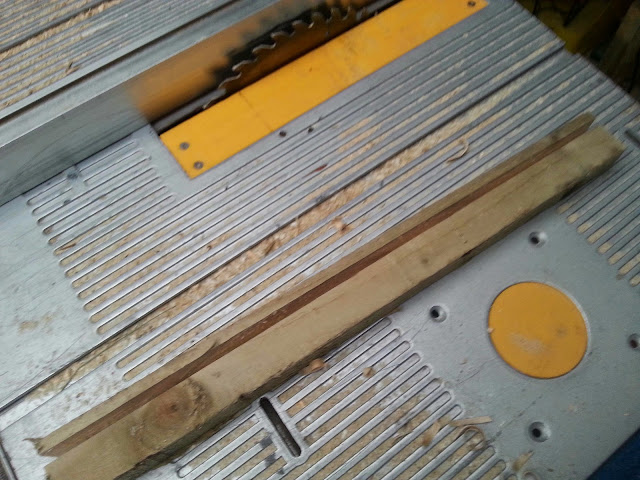
Using 40mm battons (to allow for 2mm removal by circular saw) I cut away a strip 9mm wide. 

I then cut off each end with a top to bottom angled cut (badly explained so see pic). I did this at 70mm from each end to provide a 300mm gap (430mm topbars).

I then reattach the end pieces to the baton with the narrow side inward.


Add a comb guide and Hey presto! A topbar with a removal section to allow supering. The gap at its widest point is 300mm (12") so it can take warre boxes as supers..... if I ever build them that is :s.
ps.. This little innovation will also work with my previous little project for supering with jars. Simply cut some holes into a piece of ply wood to take the jars and place on top on the superable topbars. This option should more easily allow you to close off specific jars entrances once full and removed.